Volume III, Issue II Available for Order Now


Agoo (Call*)
Amee (Response*)
Agoo
Amee
Agoo
Amee
HIDDEN BETWEEN THE WHISPERS OF THE WIND IS A WEST AFRICAN FOLKTALE OF AYANGALU; a djembe drummer who played through the streets of markets, forests, and farms before being chosen by the spirit of the talking drum. This voice carried with it, the Indigenous knowledge of resonance; oscillating between pitch, tone, and rhythm to communicate and double as the mouthpiece for generational griots.
The talking drum is struck and the story of Ayangalu echoes over from Nigeria to Ghana and meets the eight legs and two pedipalps of Ananse. The talking drum is struck and the resonance of this story with Ananse echoes over from Ghana to meet the hands of Kanu the Guardian in Sierra Leone. The talking drum is struck and the reverberation from Kanu the Guardian vibrates over to the Iroko wooden shell of the Djidji Ayôkwé; a nearly 1000-pound sacred drum belonging to the Ebrié (Atchan) people of Abidjan (Ivory Coast).
Somewhere here, a tree falls at the hands of a mechanical bulldozer. As it makes contact with the soil, a deafening sound reverberates through a forest. The sound is felt through a piercing pain in the heart of neighbouring towns.
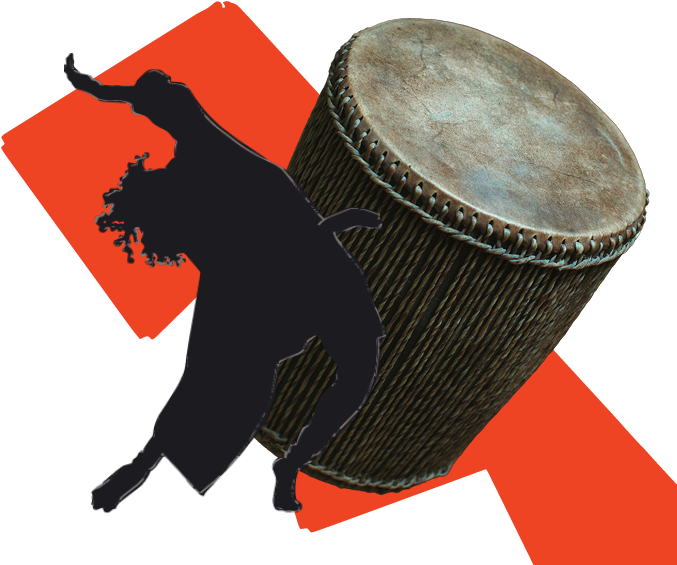
Historically, the Iroko tree is regarded in West African cosmologies as the bridge between spiritual and physical worlds; home to ancient spirits and deities. Belief systems associated with the Ogbange* revere the tree as a portal that carries the spirits of children, and due to the wood’s dense and rot-resistant nature, it also doubles as symbolization for endurance. The tree grows particularly on the west coast of countries like Ghana, Angola, Benin, Ivory Coast and Mozambique.
Somewhere here, the wind brushes through the hairs of your arms. A soft gaggle of laughter can be heard through an unidentifiable window.
During colonization in 1916 (though spiritually, this has not ended) French authorities confiscated the Djidji Ayôkwé in an attempt to suppress the independence of the Ébrié (Indigenous Akan people largely situated in Ivory Coast). The purpose here was to prevent the drums’ ability to be used as a tool of inter-village sonic communication, to announce death, celebration, and ultimately calls for resistance. After being seized, the Djidji Ayôkwé was taken to Paris, where it was stored for over a century in institutions such as the Musée du Quai Branly.
Somewhere here, a vacuum of silence feeds its pregnant belly. Everything is quiet.
The trauma of colonial looting is not an isolated one, nor is it a phenomena that has ended. Specifically in relation to land liberation and food sovereignty, the call and response of Black Indigenous knowledge starts in the hands of openness and ends in the hands of an intergenerational adage, passed down. Contrasting this, the call and response of Western Borrowed Knowledge starts in the hands of theft and ends in the hands of failure to acknowledge those who came before. The muscle memory is shared. The intentions behind them are not.
An example of this is evident in the 2012 enactment of the Seeds and Plant Varieties Act, which criminalized the sharing, exchanging, or selling of ‘uncertified and unregistered’ Indigenous seeds through community seed banks. Indigenous seeds, particularly in places like Kenya, are more drought resistant and adaptable to the climate conditions of their native areas. Consequently, they often outperform hybrid seeds imported from elsewhere. Farmers who were found guilty in the sharing of Indigenous seed knowledge faced up to two years in prison or fines up to $7,800. The law also gave government officials power to raid seed banks and seize seeds that they deemed to be ‘illegal’. Naturally, this was a discretionary power. Naturally, this monopolized seed trading rights for companies who could afford to be licensed. Inevitably, we remember how the muscle memory of this very specific type of violence often traces back to one group of people. This law was only deemed unconstitutional in 2025—13 years after it was initially passed.
Somewhere here, a Djidji Ayôkwé resounds with a rhythm of recognition. It, too, has known the pain of merciless waiting through merciless time.

There is a certain irony in this process of inter-Indigenous knowledge (also known as TEK: Traditional Ecological Knowledge) being criminalized while the same knowledge is continuously packed, repackaged and regurgitated en masse to Western audiences through the churning of ‘self help books’ and compartmentalised data driven formats. Under the gloss and formatting of most infographics, is an Indigenous voice being spoken over. What can we do to dig through this and find the spirit that lays at the root? What can we do to access the source of information that has been repackaged to us? We can listen to our local drums. And what happens when we have no access to a physical drum? We use our bodies. After the drum was discovered to be a covert communication network amongst enslaved people, a ripple effect of drum demonization was consequently presented by enslavers who criminalized the use of drums in countries such as Barbados, Jamaica, and similarly banned by Christian missionaries in Ghana, Nigeria, Senegal and Ivory Coast, due to fears of the drum acting as a vessel to sustain African spiritual practices. What they (enslavers/missionaries/those lacking the rhythm of spirit) did not realize was this: when the beat of the drum has no body, the body becomes the drum.
Somewhere here, a steady transcontinental beat can be heard in a slow crescendo.
The drum here is used as an allegory for local voices that have been cultivating their trade for decades. Farmers, land and cultural workers, grandparents/guardians, and curious children passing on offerings they don’t yet understand themselves from the spirit world. Not all forms of knowledge take shape through words. Sometimes they take shape through a drum that can be only heard if one takes the time to listen. Sometimes they take shape through ancestors (whether living or passed) that only speak when a direct question is asked. The land beneath our feet is patiently waiting for the dots to be joined between cross cultural food sovereignty and land liberation efforts. Olive tree growing practices in Palestine are not so far removed from methods used in South Africa, Tunisia, or Chile. The shea butter nut growing trade in Ghana is not so far removed from methods used in Senegal, South Sudan, and Uganda.
Somewhere here, Ayangalu, Ananse, and Kanu the Guardian smile with the memory of familiarity.
Ngũgĩ wa Thiong’o speaks of the English language as a “cultural bomb” that alienates African writers from their communities, erases Indigenous histories, and perpetuates Eurocentric hegemony over African cultures. This phenomenon is not limited to African writers alone. If the English language is the bomb, perhaps a focus is required on the drums, or, other sensorial forms of communication that can diffuse and act in a similar way to the Djidji Ayôkwé; a drum fuelled tool of resistance and inter-village sonic communication. Outside of infographics and aforementioned books which serve as a graveyard of Indigenous knowledge, how can we honor the voices that previously and currently strive to share portals of Indigenous knowledge to those who so desperately need to hear it?
Agoo (Call*)
Amee (Response*)
Agoo
Amee
Agoo
Amee
When the Talking Drum calls, what muscle(s) are we using to respond?
Agoo (Call*) / Amee (Response*) is a traditional call and response in Ghana. The call. “Agoo!” means “attention, please.” The response “Amee” means, “you have my attention.” It is also seen as a polite way to announce your presence at someone’s door/to ask someone to excuse you so you can pass.
Ogbange* is a concept in traditional Igbo mythology/spirituality. Its literal meaning in the Igbo language is “children who come and go”.