Volume III, Issue II Available for Order Now


EVERY YEAR, THE MEDIA CHURNS OUT ANOTHER APOCALYPTIC HEADLINE DECLARING THAT NEW ORLEANS IS RUNNING OUT OF TIME. These stories thrive on catastrophe, turning a living city into a spectacle of inevitable collapse. For outsiders, the alarm bells may ring. But for the folks who call New Orleans home, especially Black communities on the frontlines, the reality is far more nuanced than the clickbait narratives that dominate national coverage.
This interview features a conversation with Dr. Jasmine Jackson, Co-Executive director of the National Black Food and Justice Alliance, supervisor of Louisiana Crescent Soil & Water Conservation Districts, and a native of New Orleans’ Ninth Ward. Her reflections challenge the dominant climate discourse and return us to a fundamental truth: Black people are not an afterthought in the story of New Orleans, we are its foundation. If climate solutions do not protect Black communities and defend Black futures, they are not solutions at all.
I’m a New Orleans’ Ninth Ward native. I come from a long line of New Orleanians who were caregivers and hard workers. My connection and relationship with the city is deeply personal, lately it’s been political and absolutely cultural. But, overall, it’s ingrained in me, it’s ancestral. I haven’t traced my family back any further than New Orleans, though I’m sure we go back further.
New Orleans helped shape how I understand survival, being a teenager when Katrina hit. That definitely shaped how I understand community in relation to food, land, and resistance. Growing up here taught me that Black communities have always created systems of care despite abandonment. Whether that’s food, music, mutual aid, or especially our church networks, we’re like deep in the Black Catholic game here. The second lines are rooted in the social aid and pleasure clubs, which many people don’t know. Folks have been coming together for generations to support each other, and that’s just a neighborhood tradition. For example, my mom and aunties love organizing a Pitty Pat game—it’s a real thing, the whole household can end up with a cut. I think about supper plates. I love that I can pull up, get a plate, and support a local business. Black people have built and continue to sustain the soul and economy of this city.
Everything people around the world celebrate about New Orleans exists because of Black people. Our food, culture, labor, the hospitality industry, especially our music—from bounce to jazz to blues, our language—I’m always getting asked to say baaaby—the way we celebrate, show up in our neighborhoods, it all comes from our Black community. We continuously produce the culture while enduring displacement, divestment, and especially environmental harm. My neighborhood is currently fighting a grain train terminal, the expansion of the canal, and the constant sales of residential land to developers. This city shows the violence of systemic neglect, but it also shines a light on the brilliance of Black community survival strategies. New Orleans has taught me that communities often survive not because institutions reach out to save them, but because everyday people organize, share their resources, and fight for one another.
The [media outlets] are getting under my skin. I’ve gotten so many calls about it. But honestly, the dominant narrative treats New Orleans as a tragic spectacle instead of being clear about the policies and industries that created this condition. Climate change is not just a simple natural disaster here. Yes, we’ve had storms, we continue to have flooding, but it’s the result of the extraction, the racist housing policies, the wetland destruction, the oil and gas infrastructure, all of those abandoned rigs still there, the speculative development, the two-acre lot right across the street that just got sold to some developers from the school board. And on top of that, the decades of disinvestment in Black communities.
I feel like what gets missed [in news coverage] is that we’ve already been adapting and surviving for generations. People are building raised houses, making backyard canals for water to drain properly. We’re not just sitting around waiting. People are organizing around food sovereignty, mutual aid, and cooperative economics, which is a big movement right now. There are childcare and housing co-ops; it’s just beautiful to see. Folks are focusing on land retention, hurricane disaster responses, and overall neighborhood survival.
NEW ORLEANS HAS TAUGHT ME THAT COMMUNITIES OFTEN SURVIVE NOT BECAUSE INSTITUTIONS REACH OUT TO SAVE THEM, BUT BECAUSE EVERYDAY PEOPLE ORGANIZE, SHARE THEIR RESOURCES, AND FIGHT FOR ONE ANOTHER.
These media narratives erase the fact that everything people love about New Orleans comes from Black people. We are so often the first people displaced when the city becomes profitable again after a disaster. We have lost over 123,000 Black residents since the early 2000s. Katrina happened in 2005, but right before then, they had already knocked down all the housing projects. There’s a significant decrease in the number of children living in this city. A lot of the schools did not reopen post-Katrina. These numbers aren’t telling us if displacement is happening—we know that it is—it’s telling us that Black people are being displaced while others get to benefit from our displacement.
Clickbait headlines point out the worst-case scenario, but it’s not the most likely scenario. When you dig into what researchers are suggesting, they say that these alarming headlines are not fixed. There are decisions we can make today that’ll definitely shape the outcome. Scientists are not being heard, but they’ve repeatedly stated that we have to build land and restore the wetlands—that’ll help buy us time. In Louisiana, we’ve been investing billions—with the big B—of dollars in coastal restoration, levee protection and rebuilding, wetland restoration, and even resilience infrastructure. For example, we have the largest habitat restoration and sediment projects in the country. We have the seventh-largest estuary in the world, where oysters grow—these oysters are important because they help rebuild natural coastal barriers and reduce erosion. Rain gardens are being installed in every ward throughout the city. We have coastal vegetation programs where they’re actively growing the native wetland plants and planting them in boats.
It’s not a question about the solutions. The question is, do we have the political will to implement these solutions fully? Governor Jeff Landry’s administration, along with the Coastal Protection and Restoration Authority, and federal trustees, canceled the $3 billion Mid-Barataria Sediment Diversion in Plaquemines Parish. This was supposed to be the largest ecosystem restoration project in this country’s history and the foundation of the state’s own Coastal Master Plan. At the same time, scientists have made it clear that sediment diversion is one of the most important tools for restoration. So, the government is canceling these projects and then going and asking us as a community to absorb new industrial projects. I mentioned earlier that my neighborhood is fighting against the grain train terminal. This is a project that we know will increase pollution, train traffic, industrial activity, and derailments, resulting in chemical spills. It’ll live less than 20 feet away from people’s doors. People are already carrying environmental burdens. We already have high rates of asthma and other health issues, and they’ll just get worse with this project.
I want to make it clear. I’m not negating at any point that climate change is real. The threats are absolutely real. But the solutions are even more real. I’m not concerned about the headlines because, as I said, those are portraying the worst-case scenario, and not necessarily what’s going to happen. What concerns me most is that the people in our government are making political decisions that ignore science.
Environmental racism is determining who gets protection and who is treated as expendable. Black communities here are more likely to face flooding, poor drainage infrastructure—they’re not even coming to clean out drains regularly—less access to trees, industrial pollution, and I don’t even want to get into Cancer Alley. We’re experiencing housing instability and food insecurity. In the Ninth Ward, we still don’t have a full-service grocery store. This is decades of racist planning and disinvestment. There’s a neighborhood called Lakeview near us, and the life expectancy there is 88 years old. Our life expectancy is 62 years old. Their median household income is about $150,000; ours is below $30,000. Then, right on my block, there’s one house selling for $450,000. So, gentrification is knocking on our door. I’ve been struggling to purchase a home because of the cost of insurance. Especially in my neighborhood, the utility burdens are insane.
Environmental racism is also shaping where these industrial projects are placed. We’re expected to absorb all of this extractive infrastructure in the name of economic development. When we know that those projects would never fly in wealthier communities, they’re being protected from these burdens. Climate change is real. It’s not creating these inequities. It’s magnifying them.
For survival infrastructure, it’s not about accessing food. It’s definitely about controlling the land, the production, the labor, the distribution, the markets, and even the political power. Black communities have always relied on gardening, we have a backyard gardeners network, we are fishers—my daddy catches fish, crabs, all the things, I don’t buy fish—cooperative economics, supper plates, and mutual aid to survive all the systemic neglect. These traditions are becoming even more important during these climate disasters and this economic instability. Food sovereignty is the survival part of the infrastructure, but then we also have to consider climate adaptation. If we have our local farms, community gardens, cooperative grocery stores, food hubs, fisher folks, and our neighborhood food networks, they become more resilient when the storms impact the supply chains and the food prices rise. They were talking about an egg shortage, but I know a guy who sells eggs, and he kept them at the same price.
Food sovereignty is also cultural preservation. So are all the recipes, seeds, growing, or fishing traditions. These practices carry memory and identity and help us protect our foodways. At the Alliance, we invest in our Black co-ops, we support mutual aid that goes directly to the people. We invest in policies that rule in favor of food sovereignty and land justice. We are building our tools specifically like the YAMS app, so we can collect and control our own data and narrative. Food sovereignty is saying we’re not waiting to be rescued. We’re never going to win that way. So, we’re building our systems that allow our communities to feed and protect and sustain ourselves.
I struggled with this. It’s twofold: we need honest conversations about what it means to stay, to relocate, and to return. People still haven’t come back since Katrina. We can’t allow Black displacement to become normalized. The term managed retreat can become coded language for removing Black people from valuable land. At the same time, wealthier populations move in, inherit, and try to co-opt the city’s cultural identity. We’ve seen this before. After Katrina, the government proposed this green dot map, which suggested that some neighborhoods should be abandoned. Most of those neighborhoods were– you guessed it– predominantly Black. The resistance to those plans wasn’t just about housing; it was about the right to exist, about the right to remain, and the right to return.
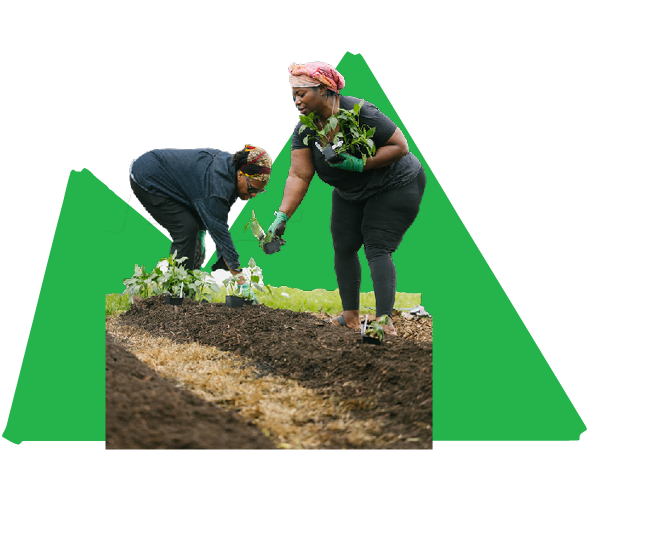
If it does reach this point, Black communities should be discussing collective relocation models rather than isolated displacement. Talk to the people on your block about what they’re up to. I don’t think that Black people should lose power, cultural ties, community networks, and collective ownership.
Ultimately, I believe we need to center conversations on how we’re going to stay. We’re not letting go. That means we need to really be investing in our wetlands, sediment diversions, more rain gardens, cooperative housing, resilient housing, and community land trusts to protect heirs property. Intergenerational land retention strategies are something we really need to lean into.
Scientists are telling us that these restoration projects can extend the community and buy us time to figure out what’s next. Right now, the headlines are treating displacement as inevitable. Black communities deserve our full decision-making power over these climate adaptation plans. Thankfully, there are some Black people and groups that are holding this work like: Dr. Angela Chalk, the founder and executive director of Healthy Community Services, Jessica Dandridge-Smith of the Water Collaborative of Greater New Orleans, Water Wise NOLA, New Orleans East Green Infrastructure Collective, New Orleans Food Policy Council, Sprout NOLA, and Recirculating Farms—these are just a few of the climate justice-centered movements resisting. There isn’t much investment in these solutions, and we need more to be better coordinated.
For outsiders, it’s important that you know that every hurricane season is unpredictable. Make sure folks in these areas know they have a safe place to go if they need to evacuate at no cost. We need no-pressure options to get out of the city during these disasters. Help people gather their to-go bags. Make sure people have their documents. Check in on your people. Make sure they’re putting money away, or put money away for them. Those are the mutual aid opportunities that are integral during these times. I don’t anticipate anything will wipe us out again. But I’ve experienced it before; my entire house was wiped out. We were in a trailer for 10 months. There are ways to be in community and solidarity, especially if you live in an area that’s not directly impacted.
Liberation-centered climate justice means moving beyond survival and toward self-determination. The communities most impacted by the climate crisis should control the resources, planning processes, and solutions that shape our futures. But this will require direct investment in a Black-led structure. Folks in the local, state, and federal governments need to support cooperative food systems, community land trusts, youth leadership, affordable housing, public transportation, healthcare access, culturally grounded disaster preparedness, science-based coastal restoration, and local energy sources. Louisiana scientists, engineers, and coastal planners have spent decades—longer than I’ve been alive—developing these solutions to rebuild our wetlands, slow land loss, and buy us time. We need policies that confront the root causes and not just keep managing disasters. We need regulation of oil companies like BP, the strengthening of labor protections for the people doing this work, and the prevention of this disaster-capitalism and speculative development. We also need solidarity across the Gulf South because our struggles are interconnected. Our Black people, our Indigenous folks, our rural folks, our fishing folks, our farming folks, and all of our working-class communities are fighting land loss. We’re fighting extraction, displacement, and environmental racism.
So ultimately, protecting New Orleans is not about preserving the buildings and the tourism. It’s about protecting Black people, Black culture, Black relationships, and the right of Black communities to remain rooted in the city we built. So, I’ll say it one more time for the people in the back: Everything that people celebrate about New Orleans exists because Black people created it, so climate change must begin with protecting the people who made this place possible.

