Volume III, Issue II Available for Order Now


“HEY PINE, CAN YOU BEAR MY WEIGHT TODAY? IF ONLY FOR A LITTLE WHILE…” I pause, touching pine bark, and listen to nature. A branch did not fall; a wasp did not sting me; life is still. I use that silence as a good sign and proceed to assemble my hammock. After my rest session, I thank the trees as I depart.
I am a 2025 graduate of Georgia State University’s Community, Soil, Air, Water (CSAW) geosciences cohort, where we challenge the ivory tower model of science education. My research is grounded in uplifting ancestors, Black farmland, and afro-futuristic education. Settler colonialism, racial capitalism, and global urbanization compromise Black youth’s access to welcoming urban greenspaces. In my studies and experiences, I often seek to understand how Afro-Indigenous approaches to environmental education reengage Black youth. I’ve found that nature-based art programs can reveal young people’s desire to connect to the past.
In this paper, I reflect on a Survivalnomics workshop series that I led in 2024 at Hartnett Farm and Bush Mountain. Through this series, I recruited Black Atlanta homeschool students, or “young maroons,” to learn cultural earth skills—including fiber art, cooking, folklore, and first aid—as a means of practicing cultural identity, sustainability, and self-determination. Survivalnomics functions as both a pedagogical framework and a practical intervention designed to address the disconnection between Black youth, land, and environmental knowledge systems.
Afro-Futurism refers to Afros—I use the term “afros” as an endearing term for African American descendants of chattel slavery and, more broadly, as a diasporic term that embraces, empowers, and unifies people of African descent—radically imagining their presence and thriving in a distant future. While the African American experience has been one of exclusion and afterthought, Afro-futurism ensures there is longevity to life and culture beyond its creation and environmental, societal, and political circumstances.
As a political ecologist observing society, it just recently became “safe” for the Black voice to document our experience without holding our tongue. The First Black Studies Department began at San Francisco State University in 1968, led by Sociologist Dr. Hare, aka the Father of Black Studies. Dr. Hare defined the environment as an aggregate of all the external conditions and influences affecting the life and development of an organism, human behavior, or society.[1] Black Geographies highlight where Black people take up space. Where do Black people eat, sleep, work, party, and simply exist? These regional distinctions embody a sense of belonging, cultural pride, and identity. The masterful scholar activist Clyde Woods deeply engages with Black geographies and regional knowledge systems, studying Haiti, Los Angeles, the Mississippi Delta and post-Hurricane New Orleans. In regards to Black expressivity through Mississippi Blues, Woods questions who gets to define blues, and later rap?[2] Our art is attached to human dignity, not exploitation, capitalism, and commercialization. Similarly, Carolyn Finney asks: who gets to define the Black experience in nature?[3]
Black geographies certainly contrast with traditional geography, that has generally been white men sharing their delight in conquest by dominating foreign cultures and stealing resources. Black geographies require grassroots collaborations to address local needs, environmental justice, and equity. It also welcomes the voices of marginalized people and prioritizes community relationships; so that we can express their lived experience with minimal repercussions.
Black people seem to face a constant battle for self expression, joy, and communal sovereignty. In Teach to Transgress: Education as the Practice of Freedom, bell hooks acknowledges traditional school as either a space for free thinking for few or a reinforcement to submit to authority.[4] Inspired by Buddhist teachings related to Thich Nhat Hanh, hooks learned that a teacher is a healer and must be self-actualized to be useful to their class. The work of the teacher is not merely to share information, but to share intellectual and spiritual growth with your students. Bettina Love teaches us that abolitionist teaching is “built on the radical imagination of collective memories of resistance, trauma, survival, love, joy, and cultural modes of expression and practices that push and expand the fundamental ideas of democracy.”[5]
Grounded in the work of these thoughtful and eccentric scholars, I sought to implement Survivalnomics as an example of Afro-Futurist practice—one that advances the intention of shaping Black narratives around what it means to be an Afro-Indigenous collective building relationships with land in Atlanta, Georgia.
The lineage of freedom farmers is an epistemic inheritance.[6] We acknowledge that anti-Black violence is connected to land and the environment. Some U.S. agriculture narratives practice erasing the Black body on agricultural soil. Whether our professions were plantation slavery, sharecropping, tenant farming, domestic service, civil rights activism, or other aspects of the modern working class, many Black Americans then and now do not own land. Despite land scandals, we nurture relationships with the land anyway for liberation. Our ancestors passed down resistance genes. Colonizers did not beat our Spirit completely because we are still here. Nurturing a green thumb is one of the greatest life skills. Sustain oneself, the family, and communication with the land.
Black and Native peoples’ ecological knowledge are tied to pre-colonial identities. In Otherwise Worlds, Tiffany King notes how the capitalist system were not designed for Native and Black people to succeed; “capitalism is supposed to be white, and Native peoples can never really escape their status as ‘nature’ just as Black peoples perpetually live in the afterlife of slavery.”[7]
Black people are Indigenous too; we are land based, communal, adaptive, and spiritual. Across the African diaspora, Black people have applied their resources and conviction to influence their tangible world. We have honored the land through multiple spiritual pathways, namely Voudon in Haiti, Ifa in West Africa, and Hoodoo in the U.S. South. We use prayers, offerings, divination, altars, herbal baths, songs, chants, planting, and harvest rituals to invoke relationships with the land. Spirit is alive, and with its guidance, Indigenous people gather healing and plant knowledge, learning how to make it shake with what they have.
Choosing to reconnect to the land is a form of resistance against colonialism. Perhaps the least documented group in history, Maroons were fugitives and enslaved runaways, consisting of Native Americans, African-Americans and poor whites, rejecting the chattel slavery system.[8] Maroons in New Orleans bayous applied tidal patterns and navigation, plant cultivation, basketweaving, boatmaking, and bartered cypress trees for food, clothing, and tools.[9] Maroons didn’t ask for permission to make use of swampy unmanageable land; instead, they co-existed with extreme heat, mosquitos, snakes, and alligators. Fugitivity encourages a strong symbiotic relationship, using the unstable landscape to their advantage. Their defiance against colonization and sustainable lifestyle reliant on ecological knowledge reinforces a prototype methodology for Afro-futurism.
Whether in Jamaica’s mountains[10], New Orleans’s bayous[11], or North Carolina’s Dismal Swamp[8], Maroons defined their own reality in a raw, rugged, antebellum system filled with laws targeted to restrict Black and Native freedom and movement. Since Maroons faced dire threats in the manmade environment of enslavement, they were forced into circumstances of attuning themselves to radically unstable natural environments.[9]
By rejecting the status quo, Maroons focused on survival-driven tasks. Similarly, I see homeschooling as a form of modern Maroonage, where youth and families choose alternatives to mainstream education. Homeschooling grants families full sovereignty to study essential life skills and literature. Both Maroons and homeschoolers possess unique survival knowledge. Though their paths to learning may defy colonial norms, the depth of this knowledge can equip future generations. Honoring ancestral wisdom prepares us for collective liberation.[12]
Improving Black ecology requires a transformation in Black economics, too. Historically, collective economic practices remained hidden because it was often unsafe for Black communities to operate outside the white economy. During the McCarthy era, national fear of communism meant Black folx risked violence—including lynching—if perceived as too socialist. Jessica Gordon Nembhard’s historical accounts reveal how, even during the Jim Crow era, Black people used collective agency, linking self-determination, community education, and cooperative traditions.[13]
Marginalization has always necessitated alternative economic solutions. Through collective work and responsibility, we can embody the Maroon spirit, uniting to nurture what matters most in today’s political climate. Collective economics might look like neighbors pooling resources to afford a funeral; even small contributions create substantial impact. Pooling money and resources is a pathway to securing freedom, land, and equipment, and to increasing economic stability, combating racism, and building community wealth. By designing and managing goods through cooperatives—such as independent schools, intentional communities, and mutual aid societies—we can ensure agency over our decisions as a Black people.
Recognizing that food sovereignty and land literacy must be integral to education, Survivalnomics offers more than social gathering, skill building, and consent-based participation—it also restores cultural identity, ecological literacy, and self-determination among Black youth.
My childhood memories are filled with weekend trips to my grandma’s house off Campbellton Road, a major intersection of the Oakland City and Bush Mountain community in Southwest Atlanta. For at least 25 years, I had the luxury of visiting her five-bedroom brick house from the 1940s. As the paternal matriarch of my family, Grandma Ola Mae’s home was the site of family dinners, a living room adorned with pictures of her offspring, and an antique room featuring a plastic couch and old speakers. Identifying with this neighborhood is truly an honor.
In 2024, my grandma passed away at the age of 88. While my family enjoyed park BBQs, we were not very outdoorsy, so I never fully appreciated the majestic wilderness in her backyard. Now, as an adult Agrarian, I feel a responsibility to uplift Bush Mountain and leave it better than I found it. It has become my duty to share Afro-Indigenous earth skills with Black youth, ensuring that the legacy of this community endures.
As a child, I thought my mom was crazy for talking to her houseplants and garden. My family would tease her, though we silently admired her fresh zucchini and thriving pothos plant. Years later, during my undergraduate journey at North Carolina A&T, I somehow caught the nature bug myself. Now, I often find myself waving at plants in the garden or along a trail. When I want to share some extra love, I get up close and offer a deep breath, knowing they appreciate the exchange of carbon dioxide and oxygen. “Hooooooooooooow are you doing todaaaaaaaaay, squash?” It’s my hope that young minds will marinate in these relationships with the land.
Western society teaches us that we are separate from and above the ant. Yet, an ant bite reminds us otherwise—it hurts! Ants possess their own agency, their own divine purpose, and a unique spirituality within the universe. Ecowomanism unapologetically acknowledges the Spirit; everything is alive, and therefore everything deserves respect.[14]
RECOGNIZING THAT FOOD SOVEREIGNTY AND LAND LITERACY MUST BE INTEGRAL TO EDUCATION, SURVIVALNOMICS OFFERS MORE THAN SOCIAL GATHERING, SKILL BUILDING, AND CONSENT-BASED PARTICIPATION—IT ALSO RESTORES CULTURAL IDENTITY, ECOLOGICAL LITERACY, AND SELF-DETERMINATION AMONG BLACK YOUTH.
When survival skills and home economics come together, we arrive at “Survivalnomics”—an Afro-futurist, land-based educational practice rooted in ancestral wisdom. Black homeschoolers who reject modern school indoctrination embody a contemporary form of Maroonage. Survivalnomics offers an alternative to standardized STEM or white-led education models. Spirit and culture form the foundation for fostering a ritual of familiarity with the outdoors. At Bush Mountain, youth agency is essential for authentic knowledge creation.
Bush Mountain is alive. She breathes through the presence of deer, turtles, squirrels, falcons, blue jays, foxes, bats, snakes, frogs, salamanders, rocks, leaves, trunks, vines, flowers, fungi, and more. Since 2022, I have had the honor of stewarding Bush Mountain as the Farm and Environmental Education Coordinator at the Historic Hartnett Farm, in partnership with the West Atlanta Watershed Alliance (WAWA).
Hartnett Farm’s story is one of transformation. Once a segregated school and Black safe haven during Jim Crow, the Hartnett School later became Atlanta’s first integrated preschool cooperative, eventually evolving into a vibrant community growing space in the twenty-first century. From 2022 to 2025, I witnessed Hartnett Farm’s continued evolution into an African diasporic educational farm and a hub for hyperlocal food distribution, operated by a dedicated farm collective who embody that practicing Indigenous traditions does not require performance. Ancestors and the living already share space—our spiritual connection to elders endures, and the land itself holds memories. The intertwined histories of Black communities and Muscogee Creeks after the Trail of Tears and during the Civil Rights era have rarely been reported. By embracing our collective agency and staying attuned to nature, we pause to reflect on how social outcasts have resisted and thrived alongside, rather than within, settler colonialism.[15]
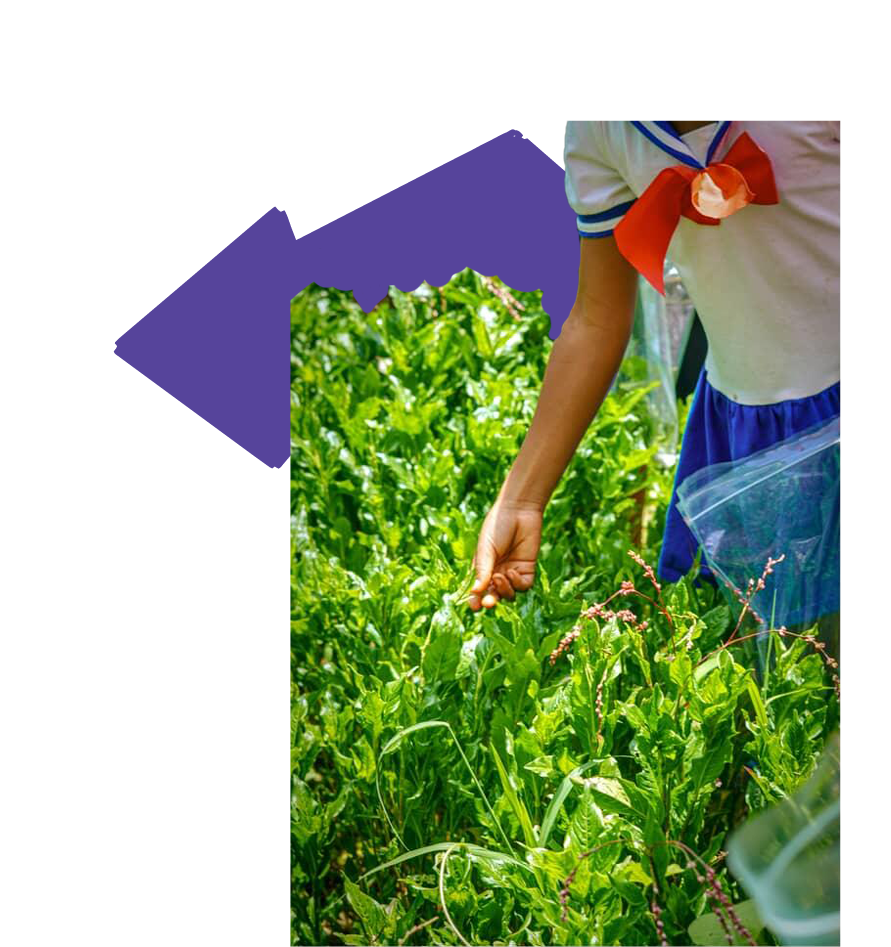
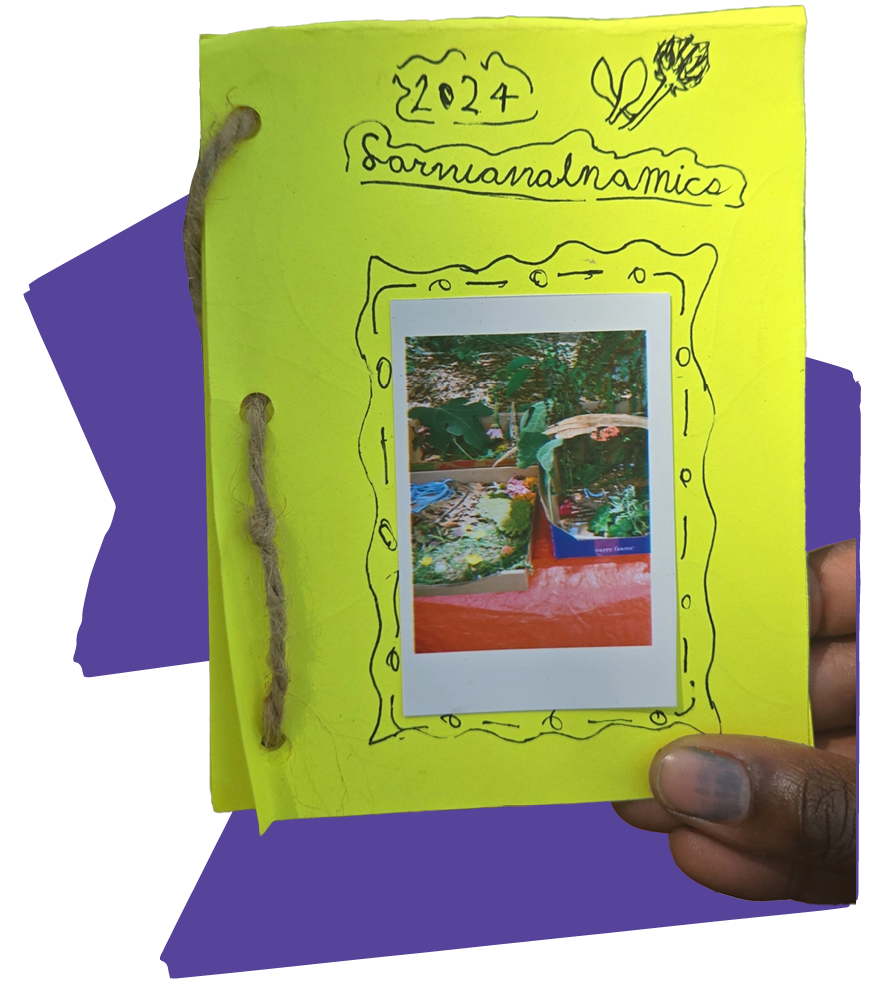
Survivalnomics, hosted in 2024, was a six-week ancestral arts and crafts workshop series held at the Historic Hartnett Farm and Community Garden. Ten young Maroons, ages 8 to 14, explored topics such as consent, diorama making, emergency first aid, fiber art with natural dyes, weaving, cordage making, and cooking—all sourced from Muscogee Creek land. To document the experience, I used a 1999 Minolta film camera, and we concluded the series by creating a photography zine of Survivalnomics.
The group of ten students included four sets of siblings. While I provided water, they brought their own lunches. Each student received a $100 stipend for attending at least four of the six classes and participating in focus groups.
Each workshop began with a folktale and ended with free play. The initial workshop focused on consent, introducing students to the intentions behind Survivalnomics. The main rule was simple: try, experiment, and keep an open mind. Encouraged to use radical imagination, students foraged around the farm to design their ideal nature spaces, bringing their visions to life through cardboard box dioramas. Landscape design became a way to practice future dreaming[15] and Afro-futurism. In addition, Mr. Robert Eagle—a Muscogee elder—visited to share knowledge about the Trail of Tears, reservations, and the Dakota pipeline, emphasizing our responsibility to care for the planet.
Found in barbershops, hair salons, the radio, TikTok, trending music, fashion, sports, etc., folklore is the casual everyday human dialogue that’s not usually recorded. Folklore is cultural, regional, and community based. African-American rhetoric and epistemes are revealed when we feel safe to be human instead of performative; speaking relaxed instead of codeswitching. Black rhetoric, knowledge, and spatialities guide the Survivalnomics space. We learn immensely from casual, informal social gatherings. Although I provided loose lesson plans, gaining collective knowledge was the objective. By teaching in ways that transgress traditional boundaries, the experience felt nothing like a regular classroom. Sometimes, street talk carries more truth than any history book ever could.
When youth were bored, I’d ask myself, what would the ancestors do? They would play, grow food, make art, share folklore, and practice protection. When we get lost in play we forget that we’re being therapeutic and ancestral. Despite politics and social drama, earth skills are always available to remind us of our humanity.
If youth can listen to folktales, sample fresh food, and find beauty in vines, then Survivalnomics succeeds. I hope students will prefer forests over screens. Environmentalism is tied to history, race, gender, and culture. Reconnecting with ancestral practices enables healing and understanding. Survivalnomics intends to spark wonder, environmental ethics, and pride in Southern culture. The future health of the land and youth depends on reconciliation of culture and nature connections.
For focus groups, I would start a sentence and ask the youth engaging in Survivalnomics to finish the sentence: Youth responses are presented below.
Prompt: Nature is...
Youth responses: “Plants,” “life,” “animals,” “creation of God.”
Prompt: Home is...
Youth responses: “Shelter,” “cover,” “make it your own.”
Prompt: Our ancestors lived around nature. What nature do you think was around them?
Youth responses: “Houseplants,” “food,” “kitchen bugs,” “mosquitos,” “rats,” “roaches,” “beetles,” “black soldier flies.”
Prompt: Farms in West Atlanta (home) connect to what other places you have traveled?
Youth responses: Georgia, North Carolina, Florida, South Carolina, Texas, Illinois, Idaho, and Belize.
Prompt: Nature is inside, too. Where is nature inside the home?
Youth responses: “Plants,” “air,” “food,” and “sun,” as well as “tables,” “phones,” “computers,” “TV,” “technology,” and “Wi-Fi,”
Prompt: Think about our Indigo Day. How does indigo remind you of home?
Youth responses: “Strings,” “jeans,” and “shirts.” Following these responses, I taught the youth about how Indigo was historically cultivated as a cash crop through enslaved labor.
Youth still terrorized ant hills. Instead of just admiring the farm’s shisito peppers, some young people decided they would make pepper grenades as they played war. During their free play time, they embodied joy as they frolicked through abundance. Sometimes they would break away to take a quick snack from a garden weed, often identifying the edible wood sorrel.
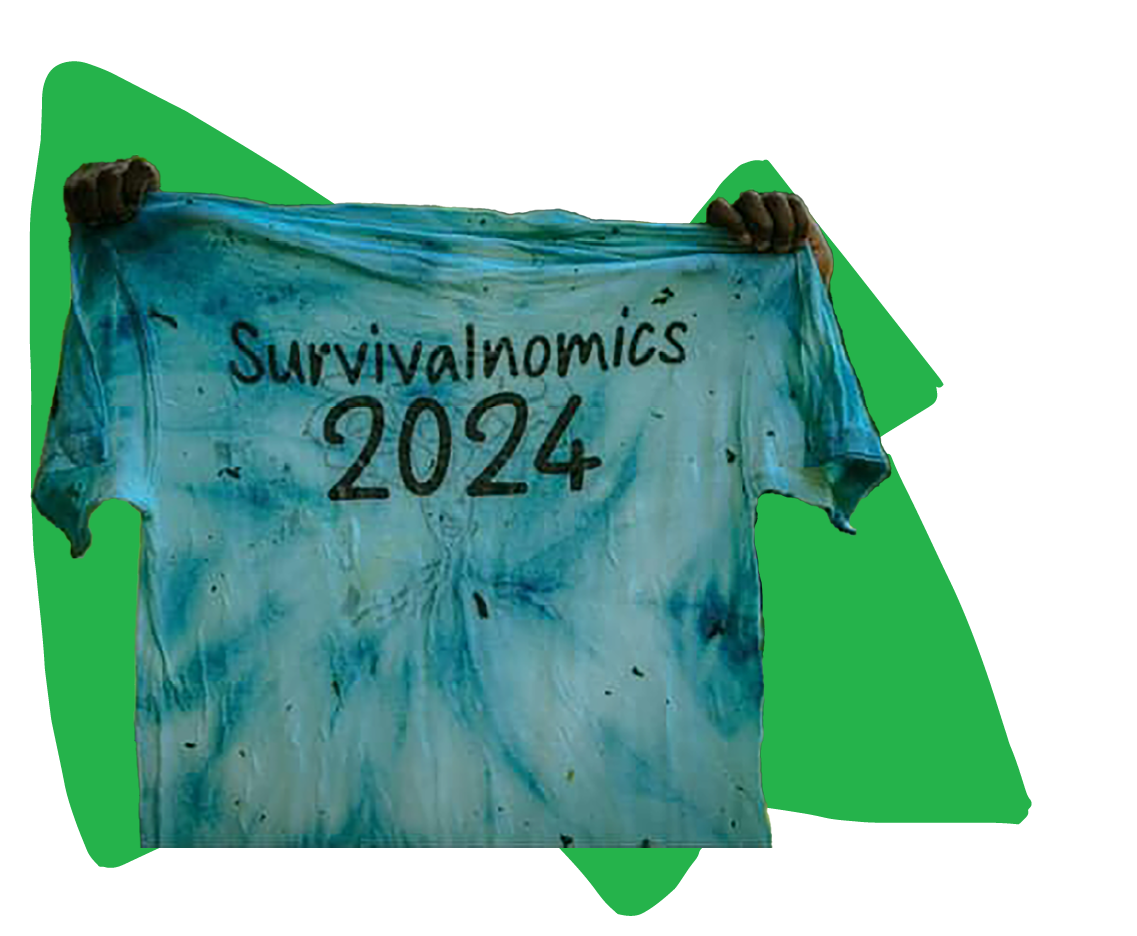
The natural dyes and emergency first aid workshop were the overall favorite activities. Youth had the full experience of harvesting the fresh indigo leaves, mordanting a cotton shirt, and watching the shirt catch the indigo pigment. They wore their shirts to class often. Weaving and cordage making, however, for many of the young people were too “boring” or “hard”. Although we practiced a simple weave with a potholder frame, this activity requires patience and detail to the “over-under” pattern using yarn. Cordage was made using the leaves of a snake plant or cattail. First we had to spoon out the plant guts with the right pressure so only fibers remain. With remaining fibers, we practiced twisting to make a simple bracelet or necklace.
While I love arts and crafts, every ancestor did not enjoy craftmaking. I’ve led basketweaving workshops with 30 adults and children and only four baskets were completed so I had to offer grace and appreciation that the youth attempted a new skill. When they were ready to give up, I told them “keep trying, do it for your ancestors!” While everyone did not leave with completed crafts, they tried each activity at least once.
There were multiple opportunities to embrace peoples’ autonomy and agency. Some of the youth were Christian and hence a tad reluctant while listening to O is for Orishas. After reading the Ogun page a student asked, “Is this real?!” I responded, “It’s as real as you want it to be”. I commended their tolerance for hearing nature elements expressed as abundant, alive, and powerful.
As a Black woman and agrarian, I am a strong advocate of life skills, but a major challenge was staying adaptive for hard conversations. Regarding Emergency First Aid, how can we help people not die? We built first aid kits, practiced body scans, and took a nature hike but I wanted to do more. I want to be soft and nurturing while explaining how to wrap up intestines in case they ever happen to fall out of a person’s body. At minimum, Black youth need to learn how to check a pulse, know how to make splints, make a clovehitch backboard, identify the land’s slope, and practice listening to the land.
Additionally, we explored how fresh food always tastes better. All the students willingly ate their personally harvested garden salad. Youth enjoyed making new friends and Hartnett Farm’s wild jungle appearance of herbs and crops bursting out of rows. As we learn old skills and play in Bush Mountain, we practice Black joy by knowing we are more than our trauma, and healing from trauma is a process.
Black homeschooling exemplifies alternative thought, embodiment, and experiential learning. Radical education means letting go of rigid traditions as a practice of freedom. Arriving with a sound mind, body, and spirit allows us to be fully present for placekeeping and active learning. Many of the youth had family gardens, making respect for nature an important family value. While nature art workshops naturally vary, classes outside U.S. temperate forests will especially differ, as teachers embrace their unique regional qualities. Regardless of whether the audience is homeschooled, publicly or privately schooled, everyone can appreciate cultural relevancy.
Survivalnomics is more than physical systems, it’s deeply ancestral and spiritual work encouraging youth to develop their identity from the inside. This was an excellent opportunity to practice abolitionist teaching and nurture intentional schools. Survivalnomics challenges youth to prioritize what’s relevant in their lives. In this workshop, we grounded in a local green space to see, touch, and breathe nature.
In Afro-futurist education, young Black minds are dared to radically imagine a green future where they exist and thrive. Formal school curriculum supports Eurocentric thinking in compartmentalizing ideas and subjects, while Afrocentric thought and cosmology sees everything as connected and secular.[17] Soil, food, and cultural survival directly connect to the Survivalnomics pedagogy as they are key ingredients to nurture a sense of belonging outdoors. Cooking and growing as an educational practice aids the transformation of land-based materials into nourishment; fibrous plants manipulated into structures are applied as ecological literacy; and first aid survival skills are environmental adaptation knowledge. Reminiscent of Maroons, we practiced being creative, adaptive, and resistant. Existing with the natural world offers abundant opportunities when we refresh our eyes.
Who better than Indigenous people to respectfully uplift Indigenous practices? It’s a privilege to uplift tales from our ancestors. Folklore preserves cultural heritage, passes down moral lessons, fosters community cohesion, and inspires creativity and innovation. Folklore was a key ingredient as youth were drawn to diverse stories relating to the Black experience. I hope subtle transformations arise, so before they kill another spider, pause to think about Anansi the spider. During the next thunderstorm, think of Ogun, look for a mermaid on the next beach visit, and ponder where Brer Rabbit is on the next hike. Old stories may remind Black youth that they belong in nature too.
Black youth need survival skills in 2026. Born with phones in their hands, each day is filled with technology distractions and spiritual warfare. I’m fighting against Fortnite and Roblox over here. Minecraft cannot teach youth what grass feels like. We are sowing seeds for young Maroons where hyperlocal nature art and recreation just might help us save the planet.
If the government is failing us and public education is questionable, we need to activate our inner Maroonage and take custody of the Afro’s future. Exposure to nature with an Afrocentric lens can relinquish the “white people stuff” stigma.[18] We resist by being nostalgic. Our future can thrive with active ongoing community events, locally and abroad.
Afro-futurist, land-based education like Survivalnomics can restore cultural identity, ecological literacy, and self-determination among the Black community. Paid, outdoor arts and culture opportunities should be normalized so youth can consider environmental and cultural careers as meaningful and worthwhile. Others can learn this too, but Afros need to take up space first. Black youth are encouraged to dream of an Afro-futuristic world not concentrated in racial capitalism. There are entirely too many invitations to the cookout. Diversity appreciation is great, but add value to your own culture too instead of constantly cosplaying others. Practicing Black speculative fiction will ensure land and food sovereignty in the long run.[19]
Survivalnomics offers a tale of cultural survival, storytelling, folklore, spirituality, and ecological literacy. Guided by Sankofa, studying ancestral stewardship teaches us how to honor human and ant together. Black youth can develop survival-based knowledge and competencies when education offered to them is decolonized. Return to Spirit. Tell stories of the past. Try peaceful silence and listen to land. Make art, play outside, and stay creative. Practice rest as resistance.[20] Don’t fear the ancestors; because of them, we are here. Move your body, bend vines into baskets, be equipped with medical basics for disaster recovery, kayak on a river, take a hike, and touch some grass. Collective agency and folklore are guides for a promising future for Black life, Black memory, and Black possibility. Make it count because we all we got.[21]
Peer Reviewed by LaDonna Redmond and Shivon Pearl Love


