Volume III, Issue II Available for Order Now


IN MARCH 2024, ARCHIVISTS AND SCHOLARS GATHERED AT JOHNS HOPKINS UNIVERSITY FOR THE CONFERENCE “WHO OWNS BLACK DATA?” PARTICIPANTS POSED A PRESSING QUESTION: “May we connect the question of control over our material heritage to the reparative movement related to colonial injustices and the evils of the trans-Atlantic slave trade?” [1] This paper interrogates that question and examines the relationship between Black food and land justice movements and community agency over the collection, storage, and use of collective data.
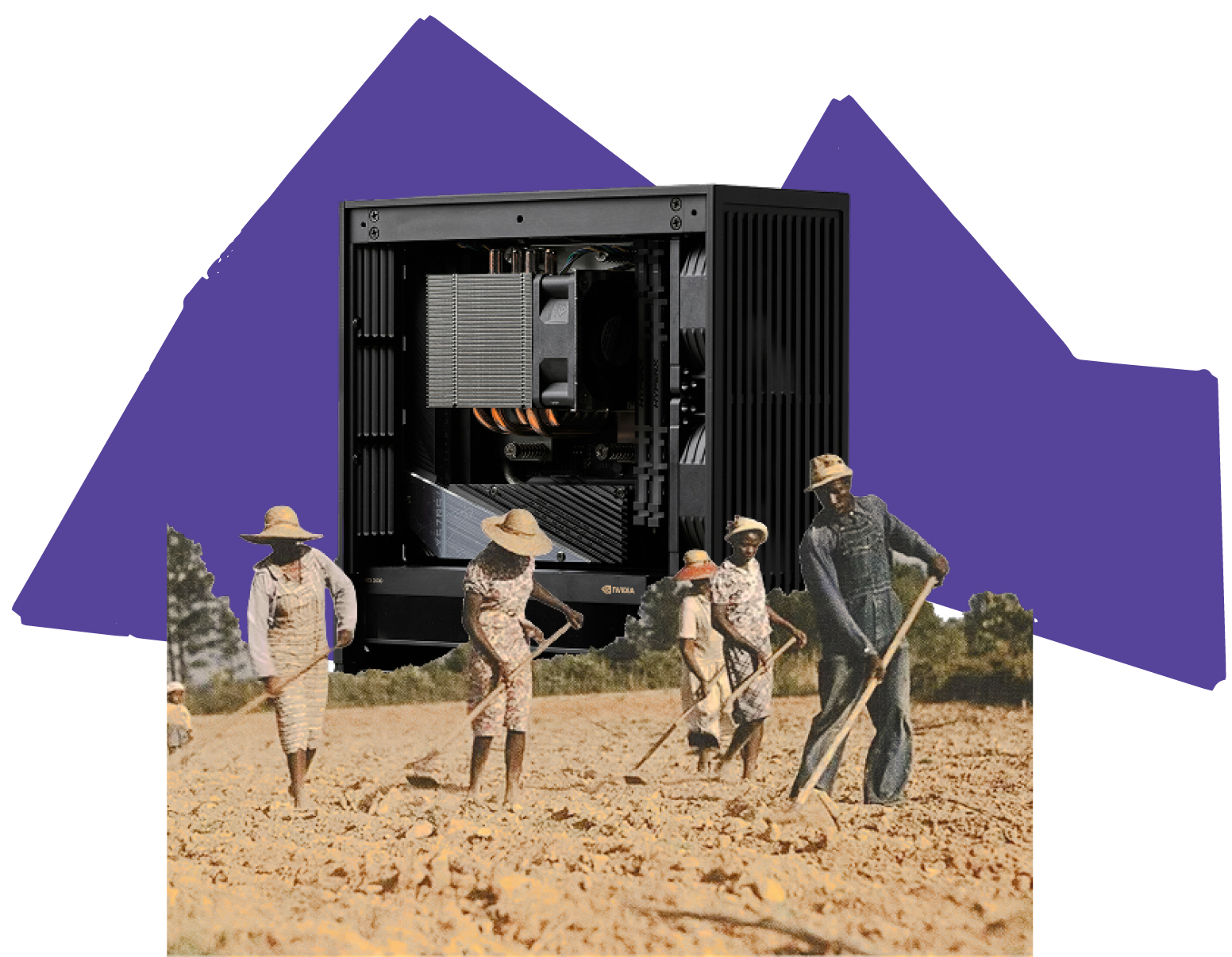
If data constitutes a form of material inheritance, then the struggle to have agency over how community information is collected, stored, and used relates to the long history of Black efforts for land stewardship and self-determination. How might technology be understood within Black food justice spaces not as the specialized expertise of individual practitioners but as a shared resource that advances food sovereignty? To address this question, the paper analyzes three distinct practices: community-owned servers, augmented reality interventions, and cooperative data governance. Together, these cases demonstrate that data sovereignty is deeply intertwined with food and land justice, and broader efforts toward reparative futures.
To understand why digital infrastructure needs to be framed as a site of land struggle, one must first recognize the scale of the extraction occurring presently. Scholars have long demonstrated how racial capitalism uses Black life as a site of exploitation. In her book Carceral Capitalism, Jackie Wang explains that under racial capitalism, “Blackness is the mark that renders subjects suitable for hyperexploitation and appropriation.” [2] What occurred during slavery did not end with emancipation. Instead, it changed form. The mechanisms through which racial capitalism extracts value from Black communities have continually evolved. One contemporary manifestation is what scholars and activists have termed the digital land grab.
IF DATA CONSTITUTES A FORM OF MATERIAL INHERITANCE, THEN THE STRUGGLE TO HAVE AGENCY OVER HOW COMMUNITY INFORMATION IS COLLECTED, STORED, AND USED RELATES TO THE LONG HISTORY OF BLACK EFFORTS FOR LAND STEWARDSHIP AND SELF-DETERMINATION.
In contemporary terms, a “digital land grab” refers to the extraction, commodification, and control of Black cultural data and community-based information by corporations and large platform companies without meaningful consent, compensation, or community governance. This pattern is not entirely new. Railways facilitated the removal of Native Americans from their lands, plantations extracted both human labor and soil nutrients, and heavy industry polluted Black neighborhoods. The digital economy similarly extracts wealth generated by marginalized communities and redirects it elsewhere in the form of profit.[3]
The concept behind the phrase also echoes earlier warnings about the enclosure of digital space. Writers at MIT Technology Review have described a “digital land grab” as corporations racing to acquire and commodify virtual land before regulatory frameworks could be established to constrain such activity.[1] A similar trend has been documented in many countries across the Global South. There, digitalization has become a major driver of land dispossession. It is increasingly common for communities to lose land because of data-driven speculation or platform-based forms of control.[4]
While these developments are contemporary, they have deep historical analogues. As Benjamin Fagan argues in American Periodicals, an earlier “land grab” occurred when for-profit companies acquired the rights to nineteenth-century Black publications and placed them behind expensive subscription paywalls.[5] Today, much of the primary-source record of early Black print culture remains controlled by proprietary databases that charge substantial subscription fees. Students and faculty at underfunded public institutions and Historically Black Colleges and Universities often cannot afford these resources, and therefore, lack access to these materials.[5]
We live within an informational environment that consistently distorts access to historical knowledge. This is not merely a market failure; it is a structural consequence of digital capitalism, a system that depends upon the continuous appropriation and processing of human behavioral data for profit.[6] As Safiya Noble demonstrates in Algorithms of Oppression, search engines and digital platforms do not merely reflect social biases; they actively reinforce them, shaping what information is accessible and whose histories remain visible.[7] For example, researchers examining nineteenth-century news circulation patterns, as in the Viral Texts project at Northeastern University, may unintentionally reproduce white bias because their datasets are often drawn from freely available databases consisting overwhelmingly of white-owned newspapers.[5]
By contrast, many historically Black records remain locked behind subscription paywalls and are therefore unavailable for analysis at a comparable scale. If private companies control the informational foundations of historical research and distribute access unequally, then inequities emerge in the production of historical knowledge itself. Eduardo Garrido-Merchán, a scholar of critical data studies at Universidad Pontificia Comillas, describes this phenomenon as a “structural privacy externality”: companies derive monetary benefits from people’s data while exposing those same communities to heightened risks of discrimination, vulnerability, and social harm. Garrido-Merchán’s analysis focuses on individual data, but the same logic applies to digitized archives and community datasets. When a corporation controls a community’s historical records, the harm extends beyond individual privacy to collective memory and self-representation.[8]
Digital land grabbing encompasses more than data and archives; it also constitutes a form of environmental racism. As M. D. Booker argues, algorithmic infrastructure and artificial intelligence systems are reproducing environmental racism in the United States today. Automated decision-making systems direct pollution, disinvestment, and surveillance toward communities of color.[9] This dynamic recalls the work of Hazel Johnson, often referred to as the mother of the environmental justice movement, who organized on Chicago’s South Side to expose how racial and economic marginalization concentrated toxic hazards in Black communities.[10] Much like earlier systems concentrated waste facilities and hazardous dumping sites in Black neighborhoods, contemporary digital infrastructures increasingly place energy-and water-intensive data centers in or near those same communities without local consent. Long before the term was widely adopted, environmental justice scholars documented how Black women led struggles against these forms of dispossession. These scholars were documenting how Black women organized in communities in Atlanta, Oakland, and other parts of the country to challenge environmental and economic racism.[11]
The damage is also cultural and historical. There are approximately 48,000 public monuments across the United States, yet fewer than 0.5 percent commemorate people who were enslaved or abolitionists.[12] The erasure of Black people from physical public spaces is therefore mirrored and amplified in digital spaces. Without control over their historical narratives, communities lose connections to place, identity, and power. A historical record that does not belong to a community cannot exist independently; it remains subject to the authority of others who may choose to alter, sanitize, or erase it.
In direct response to this systemic dispossession, Black memory workers, technologists, and organizers across the diaspora are constructing alternative infrastructures of digital land stewardship.[13] These emerging models apply the governance principles of community land trusts: collective ownership, long-term care, and community control, to the digital tools and infrastructures that support land and food sovereignty work. As scholars and organizers in the food sovereignty movement have documented, community land trusts protect physical land for collective benefit. The difference here is that these models extend that protection to digital infrastructures that increasingly mediate access to land, memory, and markets.
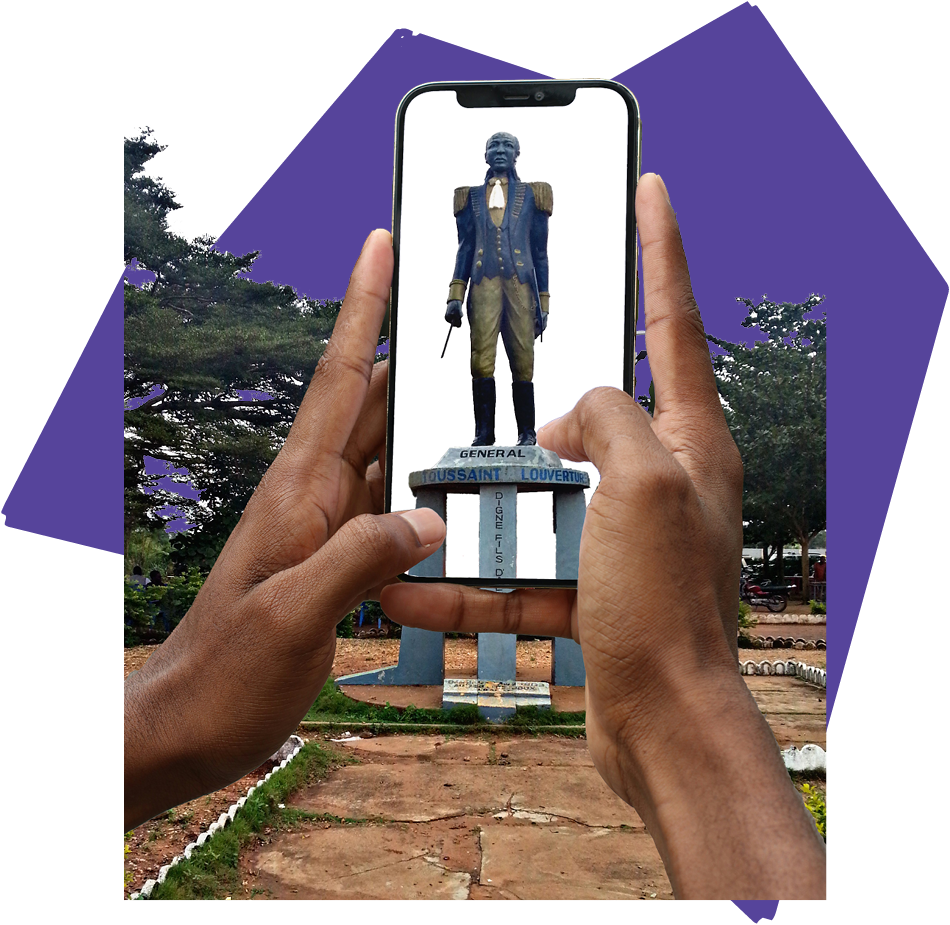
The work of Idris Brewster and Kinfolk Tech is one of the most visible examples of communities practicing digital stewardship. One project began as a digital intervention. Amid national debate over whether to remove a Christopher Columbus statue in New York City, Brewster and collaborators offered an alternative. Using free augmented reality (AR) applications on smartphones, they digitally “installed” a statue of Toussaint L’Ouverture, the eighteenth-century Haitian revolutionary, at the site of the physical Columbus monument.[14] This created a form of digital land reclamation in which L’Ouverture was placed in a historically exclusionary public space. The intervention required no physical alteration of the site. It demonstrates how digital tools can assert reclamation and resistance in spaces built on exclusion, extending the struggle over public space that the Monument Audit makes visible.
Concerns about agro-tech are closely related to those raised in critiques of the digital land grab. These platforms collect data on Black farmers through agricultural supply-chain digitalization while often keeping that data within proprietary systems. In response, the Detroit Black Community Food Sovereignty Network (DBCFSN) offers an alternative model. The DBCFSN operates D-Town Farm, a seven-acre urban farm, and has trained hundreds of people in sustainable agriculture as part of a broader effort to build a circular food economy that keeps resources within Black communities.[15] A central initiative is the Detroit People’s Food Co-op, a member-owned grocery store with more than 1,900 members.[16] Its governance structure mirrors the principles of a community land trust but applies them to both its on-the-ground site and its digital infrastructure.
At DBCFSN’s Detroit People’s Food Co-op, members vote collectively on how data (including purchase histories, supply-chain information, and food preferences) are collected, stored, accessed, and protected. Rather than allowing this data to be harvested by third-party delivery services or corporate marketing platforms, the co-op model keeps these assets under community control. Just as Kinfolk Tech preserves Black history, the Detroit People’s Food Co-op applies the same principles of collective governance to the digital infrastructure of food distribution, demonstrating that data sovereignty and food sovereignty are inseparable.
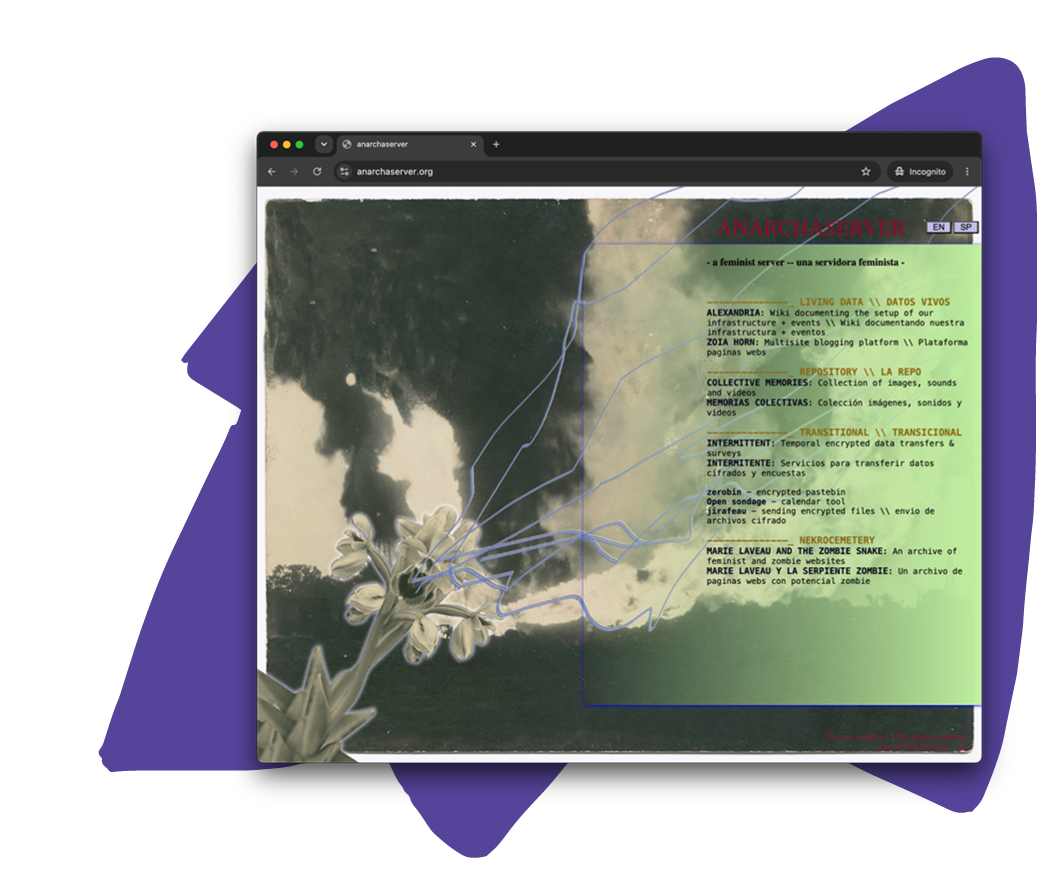
The principle that Black communities must govern the digital infrastructures that hold their histories, is also evident across the Atlantic. The AnarchaServer Project has developed into a model of digital land stewardship.[17] The project takes its name from Anarcha Westcott, an enslaved African-American woman in nineteenth-century Alabama who was subjected to non-consensual surgical experimentation by a physician later referred to as the “father of modern gynecology.” Her name, along with Betsey and Lucy who also suffered from this abuse, were erased from the medical history those experiments helped produce.[18] The AnarchaServer collective, founded by a global group of transfeminist, anti-capitalist, and decolonial thinkers, built a community-owned and collectively governed server to restore that memory and prevent further erasure. The server hosts websites, encrypted communication tools, and a growing digital archive of feminist and anti-colonial work, all governed by the community rather than a corporate platform. The project places “freedom of expression at the heart of the struggle” and practices what it calls “slow political practices,” emphasizing a commitment to offering a server that’s self-hosted to opt-out of mass surveillance, data monetization, and corporate-controlled systems.[17]
The National Black Food and Justice Alliance developed the YAMS (Yielding Access to Market Solutions) app to collect and analyze grocery purchasing data from local stores. The platform is designed to improve understanding of food access disparities, support Black cooperative economic models, and provide communities with data that can inform advocacy for equitable food policies and greater food sovereignty. YAMS operates under a data governance framework that prohibits the collection of personally identifiable information, such as names and payment details, and does not permit the sale, misuse, or commercial sharing of user data. Data is collected by a Black-led organization, securely stored, and used exclusively for research, community advocacy, and efforts to advance food justice.[19]
In Johannesburg, South Africa, the Kofifi Digital Archive Project demonstrates how a similar ethos can be applied to the memory of Sophiatown, a working-class Black suburb destroyed under apartheid and renamed “Triomf” (meaning “triumph”).[20] Former residents, alongside artists, researchers, and activists, have assembled fragmented photographs, maps, and oral histories into a community-curated digital archive.[19]
Unlike traditional museums or archives, the Kofifi Digital Archive functions not only as a repository but as an “open portal for public history” and a model of decolonial archival practice, in which the community responsible for producing the history also owns and governs its digital form.[20] As a result, no corporate entity can purchase or restrict access to the archive, nor can external institutions unilaterally determine how the community’s history is represented. In this sense, the digital legacy of Sophiatown remains under the stewardship of the community to whom it belongs.
What lessons, then, can be harnessed in this contemporary wave of Black food and land justice movements? The answer is that sovereignty today must include the digital. Protecting a hundred acres of land through a land trust is an important and historic achievement. Yet when land history, cooperative financial records, and community oral histories are stored on cloud-based servers governed by companies with opaque terms of service, communities do not retain full sovereignty over their data, which remain subject to removal at will.
These digital stewardship projects offer a useful model. They suggest a transition toward collective agency, rather than a position of tenancy within corporate digital infrastructures. To act on this reframing, food and land justice organizations can take concrete, scalable steps. A farming cooperative can transition its data storage and communications to community-owned servers or solidarity-based hosting cooperatives operating under shared governance. Similarly, a project developing a digital archive of documents related to Black land loss should establish a clear data governance policy prior to digitizing a single document, including defining who has access to the information, why they have access, and what obligations they hold to the community. A land trust might also consider working with developers to build a “digital archive trust,” an alternative legal structure that applies the same standards of care used to preserve land to the stewardship of a community’s historical digital records. These technologies already exist, and comparable models are already in practice.
The movement for Black food and land justice has long argued that land is a portal to liberation.[13] The tools of liberation are now also digital. While a screen may seem disconnected from the soil beneath our feet, control over these tools increasingly determines who can access land. These digital spaces can be tended with the same care given to soil, becoming layers where archives grow and resistance movements remain documented. We will not allow the next wave of extractive actors to claim ownership over this digital ground or to rent out collective knowledge. The campaign to protect Black thought and data is also a campaign to defend Black futures. In the spirit of the ancestors, we have everything to remember, and we must own the ground—physical and digital—on which that act of remembering takes place.
WE WILL NOT ALLOW THE NEXT WAVE OF EXTRACTIVE ACTORS TO CLAIM OWNERSHIP OVER THIS DIGITAL GROUND OR TO RENT OUT COLLECTIVE KNOWLEDGE. THE CAMPAIGN TO PROTECT BLACK THOUGHT AND DATA IS ALSO A CAMPAIGN TO DEFEND BLACK FUTURES.
Peer Reviewed by Dr. Jessica Walker


