Volume III, Issue II Available for Order Now


ANALYSES AND APPLICATIONS OF SOCIALLY ENGAGED ART (SEA) AND AGRICULTURE ARE LIMITED AND UNDER-RESEARCHED. While the malleability of each field—that is, of art and agriculture—is explored in scholarship and individually recognized as tools for deciphering history and traditions, the nexus between the two has not been fully studied.[1] Exploration is especially lacking in the context of the Black experience. This reflective case study argues that the Growing and Growth (henceforth, “GGC”) is an example of how to use SEA as a means of fostering liberation among Black people through agriculture. Using the Near East Side of Columbus, Ohio as site for intervention, GGC demonstrates how an intentional combination of SEA and agriculture is a powerful tool for change in Black communities.
SEA is a discipline that aims to shape “social interactions as a key material for creative practice, with the intention of creating positive effects in the social sphere”.[2] The SEA framework is marked by three characteristics: 1. Community participation; 2. “a desire to work in the public sphere beyond the boundaries of the artworld”; and 3. “the ambition to actively transform (not just represent) reality”.[2] SEA is deployed to foster meaning-making about social issues through artistic participatory experiences that span technical skill development, creation, appreciation, and critique through art.[2] Further, SEA has the power to serve as a “holding environment” for reflection upon and cultural adaptation of agriculture[1] and also as a conduit for modeling belonging in spaces that are not commonly thought of as being welcoming of or open to systematically excluded people. The co-founders of GGC, who are Black women, infused SEA into their efforts to encourage more people of urban-origin, especially those of African descent, of all ages and from various walks of life to grow their own food and engage in environmental wellness. The SEA approach partnered well with this objective, affording the leaders with the mechanisms needed to attract and retain participation from their audience of focus.
Art creates opportunities to express and embody distinct aesthetic perspectives that shape how people understand themselves and the spaces they occupy.[3] As bell hooks explains, aesthetics are “a way of inhabiting space, a particular location, a way of looking and becoming,” rather than something that emerges naturally.[4] Through creative practice, the history of exploitation in agriculture can be reimagined as one of resilience, possibility, and beauty.[3] This process supports efforts to reclaim and redefine Black agricultural spaces, whether in rural farming communities or urban agriculture initiatives.[3][5]
.png)
Overall, GGC uses SEA and agriculture to help participants develop their voice, exercise power, and engage in the act of creating communities that are better for all, with food justice at the center. Through programming that focuses on food and farming, community connections, and artistic expression, GGC demonstrates a relationship that is rooted in the Black experience.
GGC was founded in June 2020 by a small group of Black women community members on the Near East Side of Columbus, Ohio who care deeply about food justice. Their work builds on the legacies of activists like Fannie Lou Hammer and L.C. Dorsey and challenges dominant discourses on the roles that Black women could or should play in creating community and agriculture. Their initial goal was to revive one overgrown City of Columbus Land Bank garden so that the predominantly Black neighborhood did not lose space for growing. The Near East Side is under pressure from developers and gentrifiers to turn lots into multi-unit housing complexes. Even with these factors at play, GGC not only retained the original greenspace, but within 12 months of forming, expanded into a network of six gardens and a year-round calendar of culturally-relevant, evidence-based programming. The leaders aligned on four Impact Pillars and recently added a fifth—Agricultural Education in Cities; Food Access and Affordability; Comprehensive Health and Wellness; Equitable Community Development; and Collaboration Along the Rural-Urban Interface.
Believing that it is both possible and necessary to alter the course of racist history in agriculture, GGC builds and maintains pathways for the redevelopment of healthy relationships between Black people and the land in a manner that honors Black agrarian heritage and promotes dignity. GGC has held true to these goals and values even under sociopolitical pressure to subdue its Blackness because it is an affront to “hegemonic whiteness”[6] and it goes against the “interest of imperialist white supremacist capitalist patriarchy”[4]. Remaining steadfast to its commitments has actually attracted support across the continuum of philanthropy from a diverse range of individuals and organizations through the retreat away from diversity, equity, and inclusion following a brief surge in 2020. Rooting deeper has strengthened GGC, enabling the group to fund infrastructure, like city-connected water access and hiring personnel.
The Near East Side of Columbus, Ohio encompasses the entirety of the 43203 zip code and portions of 43205 and 43219. GGC recognizes the Near East Side as a predominantly Black community that has experienced longstanding systemic barriers to food sovereignty which is defined as food apartheid.[7] These barriers include limited community control over food systems, the widespread availability and aggressive marketing of unhealthy foods, and a corporate-dominated food system that contributes to disproportionately high rates of diet-related illnesses, such as heart disease and diabetes.[6] Nearly 40 percent of residents in 43203 live below poverty[8], which is over double the average poverty rate in Columbus [9]. The Near East Side’s zip codes were included in a study published in the International Journal of Environmental Research and Public Health that found a statistically significant rise of food security in Black households.[10] This is just one piece of empirical evidence that demonstrates inequity on the Near East Side, undergirding the need for Black-led food justice interventions that aim to uplift the Black community.
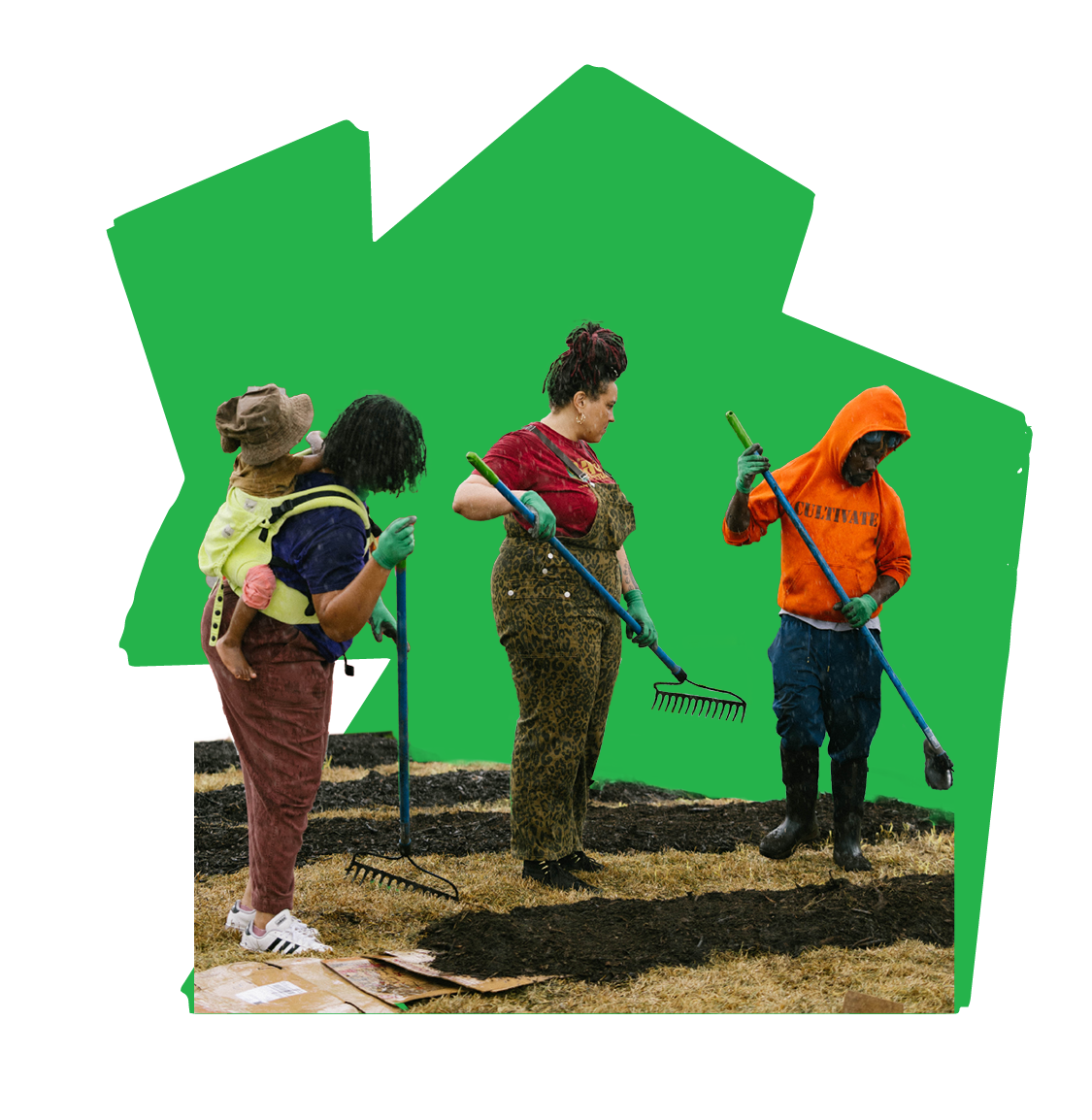
Black people in cities have long disrupted the deleterious effects of food apartheid by growing food in their yards and in gardens.[11] Violent land theft, slavery, exploitative labor practices like sharecropping, and many other forms of structural oppression are the gruesome legacies of the past that shape the present-day realities in agriculture, food systems, and wellbeing.[12] The co-leaders of GGC operate from a standpoint of deep understanding about the legacy of trauma that exists between Black people and the land. They are attentive to these truths when designing efficacious interventions.
BELIEVING THAT IT IS BOTH POSSIBLE AND NECESSARY TO ALTER THE COURSE OF RACIST HISTORY IN AGRICULTURE, GGC BUILDS AND MAINTAINS PATHWAYS FOR THE REDEVELOPMENT OF HEALTHY RELATIONSHIPS BETWEEN BLACK PEOPLE AND THE LAND IN A MANNER THAT HONORS BLACK AGRARIAN HERITAGE AND PROMOTES DIGNITY.
GGC’s co-founders naturally gravitated to art as a medium for effectively fostering culturally-relevant appeal, participant reflection, and sustained engagement.
Jera Oliver and Adrienne Williams—GGC’s founders and current leaders—attended arts immersion schools in the Columbus City Schools system, and they graduated from Fort Hayes Arts and Academic High School. Fort Hayes infuses art into the curriculum, using it “as the adhesive that unites and interrelates all other subject areas”.[13] Oliver and Williams both possess an academic understanding of art’s ability to serve as a canvas for the Black aesthetic[3], but they have rich backgrounds in community art and advocacy on the Near East Side, too.
The community is home to the nearly 100-year-old Lincoln Theatre, a historic venue developed, designed, constructed, and managed entirely by African Americans, alongside the Maroon Culture Lab (formerly the Pythian Temple), another Black-led cultural space.[14] As a young person, Oliver performed Katherine Dunham Technique and Harlem Renaissance-era poems on the stages of the Near East Side. Her godmother, Mrs. Catherine Willis, who has received countless commendations for her community arts leadership, co-founded Friends of Art for Community Enrichment and spearheaded Urban Strings Columbus (a majority-Black youth orchestra). Leveraging her connections, Oliver secured Urban Strings as a featured performance during GGC’s fifth anniversary celebration. They enlivened the room with spring-themed musical selections.
In the early 2000s, Williams worked as a summer camp counselor at the King Arts Complex (KAC), which is a premier arts organization that exists to preserve, produce, and present the cultural expressions of African Americans. Nearly 20 years later, Williams was invited by KAC leaders to serve as a virtual agricultural education workshop leader during the 2020 summer camp. Her curriculum draws on the art of the late Aminah Robinson whose unique pieces that “saluted the work hands do: growing our food, feeding us, praying, touching others, making art”[15] are displayed at the KAC. Adrienne’s volunteer engagement expanded to include gardening workshops for senior citizens during KAC’s First Tuesday Tea series and management of the GGC-established on-site Julialynne Walker Gateway Learning Garden, which is named after an agricultural titan in Columnbus who founded the Bronzeville Growers Market on the Near East Side.[16]
Since 2020, GGC has established explicit examples of SEA and agriculture through the lens of the Black art aesthetics. As noted above, GGC maintains a partnership with anchor institutions like the KAC that include onsite gardening workshops, youth arts camps, and programming for seniors ages 55 and older. Additionally, GGC collaborates with multiple entities to host 4-H Special Interest (SPIN) Club experiences that emphasize Black heritage crops and urban environmental issues. Group art projects are included to support synthesis, reflection, and knowledge retention. For instance, people take turns drawing elements on a food supply chain and identify the value of gardening to shorten the chain, and they are asked to sketch, color, and present maps of their neighborhoods to contemplate their proximity to healthy food.
GGC’s Growers and Griots series exemplifies how art can serve as a conduit for connecting culture, legacy, and community to Black foodways. Structured as a narrative arc, the 2024 series opened with an in-person event, An Evening with Chef BJ Dennis, featuring the Black Southern foodways expert who appeared in the first season of Netflix’s High on the Hog. The program was followed by monthly screenings of episodes from the second season of High on the Hog, which explored Black agricultural traditions. Each screening concluded with a moderated discussion led by agricultural economics professor Dr. Jared Grant. The series culminated in Deeply Rooted, a trip to Charleston, South Carolina, that examined the history of Black farming and the agricultural traditions of the African diaspora. By using live events, film screenings, and immersive travel experiences as forms of storytelling, the series foregrounds the interconnected histories of Black communities and agriculture, exemplifying SEA and hook’s perspective.
This examination of GGC demonstrates how socially engaged art can be operationalized within land-based initiatives to position agriculture as a site of creativity, cultural expression, and liberation. Rather than treating art as an addition to agricultural programming, GGC integrates it into its curriculum and community initiatives to advance its mission and support the ongoing pursuit of Black freedom. By intentionally combining artistic practice with agricultural education, the organization creates opportunities for participants to reflect on the histories and cultural significance of farming while reimagining agriculture through a Black cultural lens. In doing so, art becomes both the aesthetic framework through which agriculture is experienced and a space for critical reflection and action.
GGC’s work foregrounds SEA and is a blueprint for other Black scholars, food justice activists, and others who are building liberation projects. The organization’s intentional weaving of SEA and agriculture offers an opportunity for rigorous scholarship in an emerging and underexamined area of study. GGC hopes to serve as a guide for other organizations that are considering art projects for movement building in agriculture.
Peer Reviewed by Dr. Bobby Smith and Dr. Psyche Williams-Forson


